
Fire Protection System in Bangladesh
Mechanism Trade & Engineering Ltd. (MTEL) is a leading ISO 9001:2015 certified Fire Protection System Solution Provider in Bangladesh. We deliver fully engineered, code‑compliant fire safety solutions designed to life safety, safeguard lives, protect assets, and ensure operational continuity across industrial, commercial, and residential facilities. Our fire protection systems integrate advanced fire detection, reliable suppression technologies, intelligent alarm systems, and robust passive fire protection measures. Every solution is customized according to BNBC, NFPA, ACCORD, ALLIANCE, and RCC standards—ensuring dependable performance during real emergencies.
Supported by strong engineering expertise, certified equipment, and professional technical teams, MTEL provides complete end‑to‑end fire protection services: Fire hazard assessment & system design, consultancy Product selection & supply Installation guidance & supervision, consultancy Testing, commissioning & documentation Preventive maintenance & long‑term service Whether your project involves a industry, factory, hospital, office building, warehouse, data center, commercial complex or tower, or high‑rise residential development, MTEL ensures efficient, compliant, and long‑lasting fire safety systems across Bangladesh. Bangladesh’s rapidly growing industrial and commercial sectors face increasing fire risks due to dense infrastructure and high‑value operations. A professionally engineered Fire Protection System is essential for life safety, asset protection, and regulatory compliance. MTEL delivers complete fire protection solutions—from hazard classification and engineering design to supply, installation, commissioning, and maintenance—ensuring your facility remains protected and ready for any emergency.
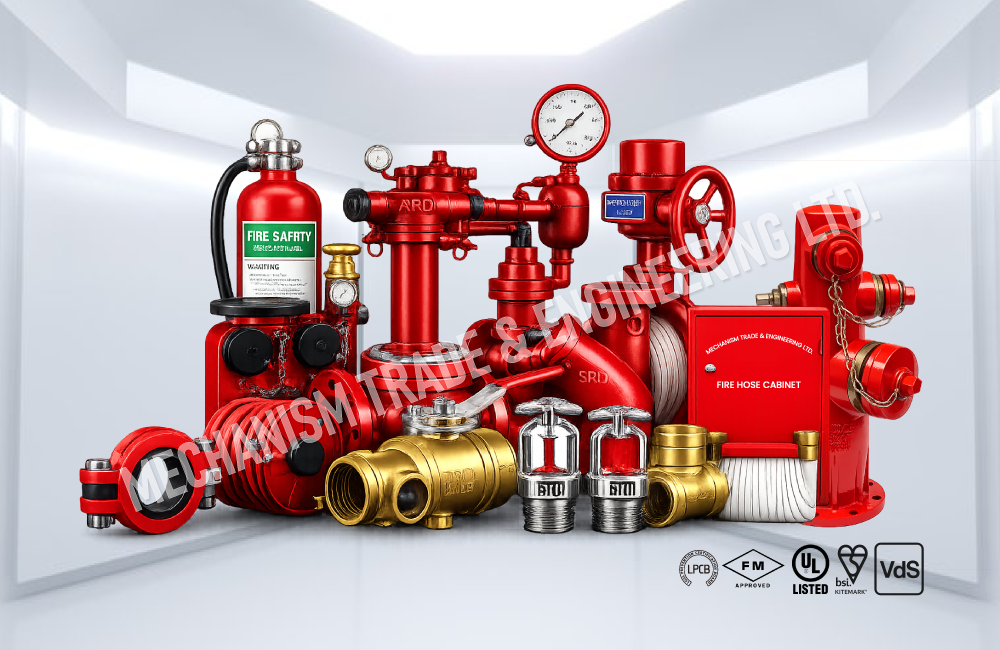
What Is a Fire Protection System?
A fire protection system is an integrated network of detection devices, suppression equipment, alarm systems, and structural safeguards designed to identify a fire in its earliest stage and respond automatically — or support manual response — before serious damage occurs.
Every fire requires three elements to sustain itself: heat, fuel, and oxygen. Remove any one of these, and the fire dies. A well-engineered fire protection system is built around this principle — detecting the conditions that allow fire to grow, then eliminating one or more of those elements as fast as possible.
Active Fire Protection (AFP)
Systems that respond dynamically to a fire — sprinklers, suppression agents, alarms, and extinguishers.
Passive Fire Protection (PFP)
Structural measures such as fire-rated walls, fire doors, and compartmentalization that slow the spread of fire and smoke without human or mechanical intervention.
Both categories must work together. A passive system without active detection gives people no warning. An active system in a building with no compartmentalization allows fire to spread while suppression is still activating.
Types of Fire and Why Classification Matters
One of the most critical and often overlooked aspects of fire protection system design is matching the suppression agent to the specific type of fire present in your facility. Using the wrong agent can make a fire worse.
| Fire Class | Fuel Type | Common Locations |
|---|---|---|
| Class A | Wood, paper, cloth, plastics | Offices, warehouses, schools |
| Class B | Flammable liquids — fuel, paint, solvents | Refineries, paint factories, garages |
| Class C | Electrical equipment | Server rooms, substations, switchgear |
| Class D | Reactive metals — magnesium, sodium, potassium | Chemical labs, metal processing plants |
| Class K | Cooking oils and fats at high temperature | Commercial kitchens, restaurants |
A factory floor handling both flammable liquids and electrical equipment, for example, needs a fire protection system configured for both Class B and Class C hazards — not a single water-based system.
Active Fire Protection: Detection and Suppression
Fire Detection and Alarm Systems
Early detection is what saves lives. A modern fire protection system incorporates multiple detection technologies working in parallel:
Thermal expansion detectors respond when ambient temperature crosses a fixed threshold — typically used in high-dust environments where smoke detectors produce false alarms.
Ionization and photoelectric smoke detectors identify smoke particles in the air well before flames become visible.
Ultraviolet and infrared (UV/IR) detectors detect the radiation signature of actual flames — particularly effective in open industrial environments.
Heat- insulation and fusible link detectors go off mechanically when they get really hot at a certain temperature. This usually happens in sprinkler heads.
* These sensors plug into a fire alarm control panel also called FACP.
The FACP then sets off beeps and flashing lights. It also tells the fire department, about the issue. It can even automatically turn on systems that put out fires.
Automatic Sprinkler Systems
The automatic sprinkler is really important for commercial fire protection systems. When a sprinkler head gets too hot it turns on. Sprays water right where the fire is. It does not spray water everywhere in the building. The automatic sprinkler is a part of keeping people safe, from fires and it works by using the automatic sprinkler to put out the fire.
Each sprinkler head has two core detector types:
Fusible link type
A eutectic alloy link melts at a precise temperature, releasing water pressure through the nozzle.
Frangible bulb type
A heat-sensitive liquid inside a glass bulb expands until it shatters at its rated temperature, opening the nozzle.
Only the heads directly above the fire activate — keeping unaffected areas of the building completely dry and minimizing water damage.
Wet pipe systems keep water pressurized in the pipes at all times — the fastest and most reliable option for standard environments. Dry pipe systems hold pressurized air or nitrogen instead of water, making them ideal for freezing environments or spaces where accidental water discharge would be catastrophic.
Standpipe and Hose Systems
For buildings and buildings with many floors the standpipe systems have pipes that are already in place and hoses that can be used on each floor. The standpipe systems are really useful for these buildings and multi-floor structures because they have pipes and hose connections, on each floor level.
Wet standpipes remain pressurized and can be accessed by building occupants for immediate response. Dry standpipes are connected by firefighters on arrival — a critical design feature for high-rise buildings where pump trucks supply water from ground level via Siamese connections.
Fire Suppression Agents Beyond Water
Certain environments cannot tolerate water-based suppression. Server rooms, telecommunications facilities, aerospace storage, and medical equipment areas require specialized agents:
Carbon dioxide (CO₂)
displaces oxygen to extinguish Class B and C fires without leaving any residue — but is ineffective on Class A fires.
Clean agent systems (Halotron, FM-200)
Electrically non-conductive, zero ozone depletion, and extremely low global warming potential. Certified for Class A, B, and C fires. These have replaced Halon 1211 as the standard for sensitive equipment protection.
Foam-based systems
Foam-based systems are really good at making a layer of water over the surface of fuel that is based on hydrocarbons. This layer stops oxygen from getting to the fuel. It also stops the fuel from turning into vapor.
Dry chemical powder
Dry chemical powder is really good at putting out fires. It has something called Sodium bicarbonate in it. This stuff makes a cloud that stops the fire from spreading in Class B and C fires.
Foam-based systems are great for putting out Class A and Class B fires. You will usually find these kinds of fires in places like oil refineries or where people store lubricants or in commercial kitchens where food is cooked. Foam-based systems are very useful, in these places.
The ABC dry powder is a bit different. It has mono ammonium phosphate in it. This means it can put out Class A fires too. Dry chemical powder like the ABC kind is very useful, for many types of fires.
Passive Fire Protection: The Structural Layer
A complete fire protection system includes measures right from the building design stage. They a
Compartmentalization
Fire-rated walls, floors and ceilings help keep a fire in one area giving people time to get out and for firefighters to respond.
Fire doors
These doors, by themselves to block corridors and stairwells during a fire.
HVAC dampers
They close on their own to stop smoke and bad gases from moving through air ducts into areas that're not on fire.
Fireproofing coatings
They have something called paint that helps keep structural steel safe from getting too hot. This intumescent paint protects steel, from heat so it does not fail when it gets too hot. This is a deal because it stops buildings from falling down too soon.
Emergency lighting and exit signs
These are important because they turn on when the main power is not working. This means people can still see where they are going when they need to get out of a building fast. Emergency lighting and exit signs turn on with power so people can get out safely.
Fire Extinguisher Selection Guide
Portable fire extinguishers are the first line of manual defense in any fire protection system. Selecting the correct type for each area is essential:
| Extinguisher Type | Color Band | Fire Classes | Typical Locations |
|---|---|---|---|
| Water | Red | A only | Schools, offices, textile warehouses |
| Carbon Dioxide | Black | B, C | Electrical substations, airports, server rooms |
| ABC Dry Powder | Blue | A, B, C | Homes, offices, cinema halls, warehouses |
| Dry Chemical Powder | Blue | B, C | Refineries, pump rooms, boiler areas |
| Foam Based | Yellow | A, B | Oil storage, kitchens, chemical plants |
| Clean Agent | Green | A, B, C | Laboratories, data centers, medical facilities |
All fire extinguishers installed in Bangladesh should carry BIS approval and CE certification, with maintenance performed according to IS 2190:2010 standards.
What Competitors Miss: The Gap in Fire Protection Content
Most fire protection system providers in Bangladesh focus only on selling equipment — sprinklers, extinguishers, alarms. What is rarely addressed is the engineering process that determines whether that equipment will actually work when a fire occurs:
Hazard Classification Before Design
Every facility has a unique risk profile. A pharmaceutical warehouse stores flammable solvents alongside paper packaging alongside electrical equipment. No single-agent system addresses all three hazard classes. Proper fire protection system design begins with a formal fire hazard assessment — not a product catalog.
Hydraulic Calculation for Sprinkler Systems
Sprinkler systems must be hydraulically calculated to ensure adequate water pressure and flow at every head. Under-pressured systems fail to suppress fires even when they activate correctly. This calculation is a professional engineering service, not a standard installation checklist item.
Integration of Active and Passive Measures
A sprinkler system in a building with steel or missing fire doors does not really protect you. The fire protection system needs to work as one system. It should not be a bunch of separate products. The system must cover passive measures, for real protection.
Commissioning and Functional Testing
Installation is not completion. Every fire protection system requires full commissioning — functional testing of every detector, flow test of every sprinkler zone, alarm verification, and documentation — before it can be considered operational.
Regular inspection and maintenance
Regular inspection and maintenance is what keeps a fire protection system functional when it matters most. NFPA standards and local fire codes mandate periodic checks of all key components — control valves, hydrants, fire pumps, sprinkler heads, hose stations, alarm panels, and extinguishers. Depending on building type and usage, some components need monthly attention while others require quarterly or annual review. Neglecting this maintenance is the single most common reason fire systems fail during real emergencies.
Industries We Serve
A professional fire protection system is required across every major sector:
Industrial
Garment factories, chemical plants, pharmaceutical manufacturing, food processing
Commercial
Office towers, shopping malls, hotels, hospitals
Residential
Apartment complexes, high-rise buildings
Agricultural and Dairy
Cold storage, feed processing facilities
Telecommunications and IT
Data centers, server rooms, broadcast facilities
Why Engineering Expertise Matters
A properly designed fire protection system is not a commodity product — it is an engineered solution specific to the hazards, occupancy, structure, and budget of each facility. Firms without qualified fire protection engineers cut corners on hydraulic calculations, hazard assessments, and system integration. The result is a system that passes a visual inspection but fails under real fire conditions.
Our team puts together engineering design, with products that have UL and FM certificates and we do the installation and service after that. When we say our design is cost-effective we do not mean it is cheap. We mean we get rid of things we do not need while making sure every important area is protected like it should be.
When you are looking for someone to help you with your fire protection system you should check if they have the engineering background if their products are certified, how they do the commissioning and if they can do maintenance. These things are what make a fire protection system really work not look like it does.