Introduction
A fire can begin in almost any building, but the consequences shrink dramatically when it’s caught early and the warning reaches occupants fast. A fire detection system in Bangladesh is built to pick up on signs of fire — smoke, heat, flame, or other products of combustion — and pass that information to a fire alarm or associated life-safety system.
But installing a handful of smoke detectors isn’t the same as designing a complete system. A properly planned fire detection system in Bangladesh considers:
- Building size, layout, and occupancy type
- Fire hazards and detector technology
- Detection coverage and alarm notification
- Control equipment and emergency procedures
- Backup power, testing, maintenance, and applicable codes
This guide covers how these systems work, which technologies are available locally, where they’re used, what shapes system design, and how Mechanism Trade can help businesses develop the right solution.
What Is a Fire Detection System?
It’s an engineered arrangement of devices that detects indicators of fire and sends that information to a control or alarm system. OSHA describes an automatic fire detection device as one designed to detect fire’s presence through heat, flame, light, smoke, or other combustion products.
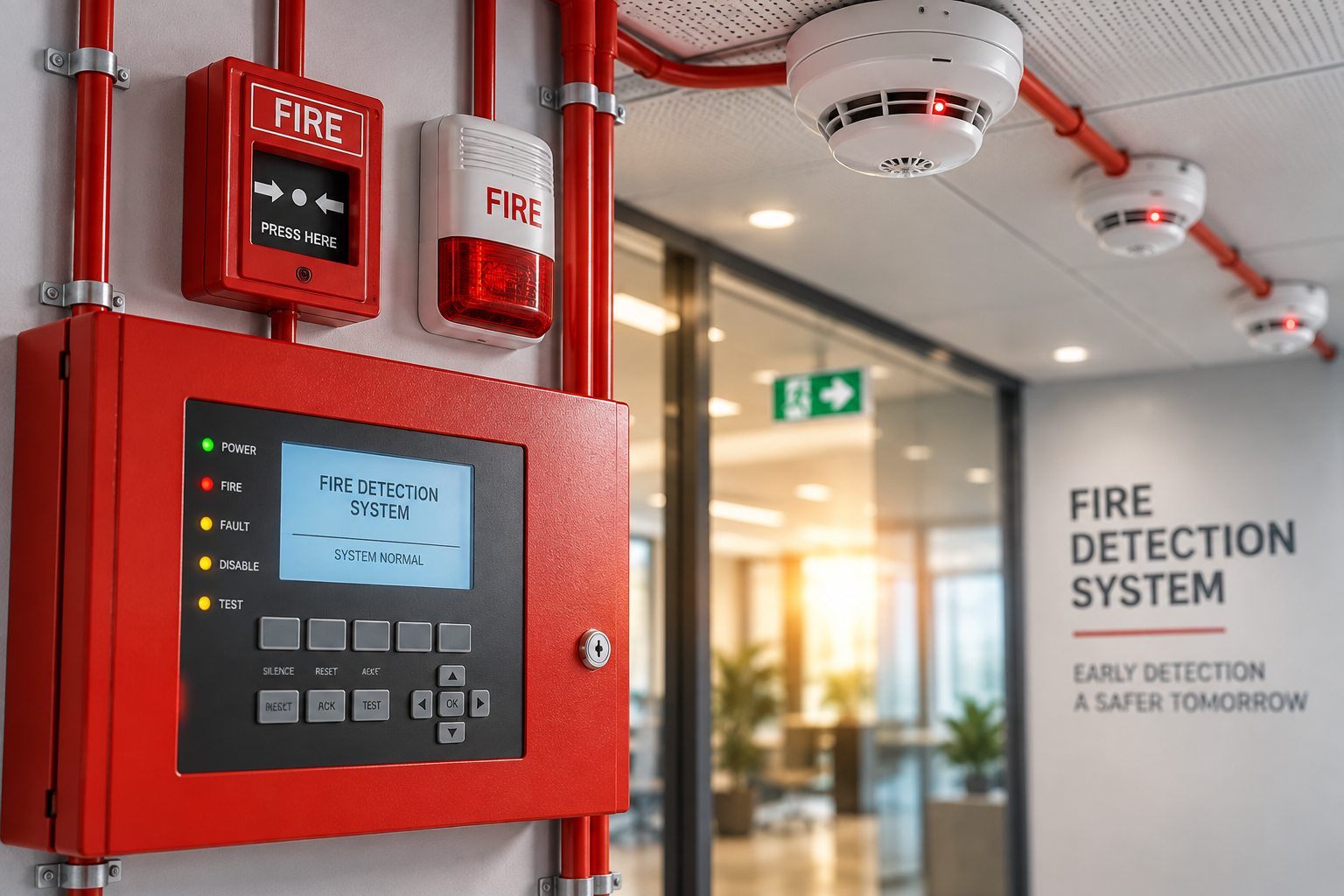
A complete system can include:
- Smoke, heat, flame, and multi-sensor detectors
- Manual call points
- Fire alarm control panels, sounders, and strobe lights
- Input/output modules and remote annunciators
- Fire alarm cables and backup batteries
- Monitoring and communication interfaces
Depending on the project, the system may also communicate with other building safety systems.
Why a Fire Detection System in Bangladesh Matters
Buildings in Bangladesh range from small commercial properties to high-rise residential towers, factories, warehouses, hospitals, hotels, shopping centers, and large industrial facilities — each carrying different fire risks. Given how densely built many Bangladeshi cities are, a working detection layer often makes the difference between a contained incident and a much larger loss.
Early detection can:
- Alert occupants and support emergency evacuation
- Reduce response time and identify the fire’s location
- Initiate emergency procedures
- Interface with other fire-protection systems
- Support firefighting operations and reduce property damage
Fire-loss research underscores why this matters. NFPA’s analysis of U.S. home fires from 2018–2022 found that nearly three out of five home fire deaths happened in properties with no smoke alarms, or alarms that failed to operate — and the death rate per 1,000 home structure fires was roughly 60% lower in homes with working alarms.
These are U.S. figures, not Bangladesh-specific statistics, but they demonstrate a principle that holds everywhere: detection equipment only protects when it’s correctly selected, installed, maintained, and actually working.
How Does a Fire Detection System Work?
The basic sequence runs through several stages: a fire develops and produces detectable indicators; a suitable detector picks up on smoke, heat, or flame; that detector signals the fire alarm control panel; the panel processes the signal and determines the response; sounders, bells, or strobes notify occupants; occupants follow emergency procedures while responders investigate; and where designed, the system may activate or communicate with fire suppression, smoke control, HVAC, elevators, access control, or building management systems. The exact sequence depends on the system’s design and programmed cause-and-effect logic.
Main Types of Fire Detection Technology
No single detector suits every environment, so different buildings call for different technologies.
Smoke Detection — Among the most widely used devices, detecting smoke particles associated with combustion. Common technologies include photoelectric, ionization, aspirating, beam, and multi-sensor detection — highly effective where smoke develops before a significant temperature rise.
Heat Detection — picks up on temperature changes instead of smoke, which suits areas where dust, steam, cooking fumes, exhaust, or other industrial conditions might otherwise trigger false alarms. Common variants include fixed-temperature, rate-of-rise, and combination detectors.
Flame Detection — Identifies radiation associated with flames, responding to ultraviolet, infrared, or a combination, depending on the technology. Useful where fires can develop rapidly with visible flame — industrial facilities, fuel-handling areas, and chemical processing.
Multi-Sensor Detection — Combines more than one detection principle (smoke, heat, carbon monoxide, and other indicators) to improve decisions where a single sensing technology falls short.
Aspirating Smoke Detection — Actively draws air through a network of sampling pipes and analyzes it for smoke particles, suited to data centers, telecom rooms, control rooms, and other high-value equipment areas needing highly sensitive, early detection.
Beam Smoke Detection — sends a beam across the space to catch smoke early, which works well in warehouses, large halls, and high-ceiling areas where standard point detectors fall short.
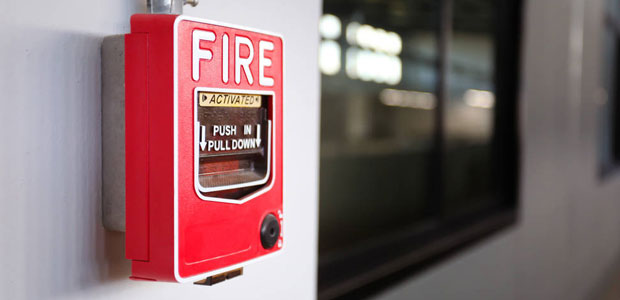
Manual Activation — Automatic detection isn’t the only trigger. Manual call points, positioned along escape routes, let anyone who spots a fire raise the alarm directly.
Here’s how the main technologies compare at a glance:
| Detection Type | Best Suited For | Key Consideration |
| Smoke detection | Offices, hotels, residential, general commercial | Fast in low-heat, smoke-first fires |
| Heat detection | Kitchens, dusty or steamy areas, garages | Avoids false alarms from smoke/dust |
| Flame detection | Fuel handling, chemical processing, industrial | Needs careful placement, environment-sensitive |
| Multi-sensor | Mixed-hazard environments | Combines signals for better accuracy |
| Aspirating | Data centers, clean rooms, high-value assets | Very early, highly sensitive detection |
| Beam detection | Warehouses, large halls, high ceilings | Reduces number of point detectors needed |
Conventional vs Addressable Systems
A conventional system divides a building into detection zones — when a detector activates, the panel identifies the affected zone rather than the exact device. It’s generally simpler, cheaper up front, and works well for small offices, small commercial buildings, and smaller warehouses, provided it’s still professionally designed around the building’s fire risk and code requirements.
An addressable system gives individual field devices unique identities, so the panel can pinpoint the specific device that activated. That extra detail suits larger and more complex buildings — high-rises, hospitals, hotels, large factories, and industrial facilities — offering more detailed fault monitoring, easier event location, greater flexibility, and more advanced programming.
| Feature | Conventional | Addressable |
| Device identification | Zone | Individual device |
| Initial equipment cost | Generally lower | Generally higher |
| System complexity | Lower | Higher |
| Troubleshooting | Zone-based | More precise |
| Expansion | Application-dependent | Often more flexible |
| Large building suitability | Limited in some cases | Generally stronger |
The right choice comes from the project’s actual requirements, not just the purchase price.
Where Is a Fire Detection System Used in Bangladesh?
These systems show up across a wide mix of settings, and what’s needed often depends heavily on the environment:
- Factories and manufacturing plants face a combination of risks from heavy machinery, combustible materials, electrical equipment, and chemicals on site
- Garment and textile facilities deal with dust, fabric, production machinery, and expansive storage spaces — a point that carries extra weight given the scale of Bangladesh’s textile sector
- Warehouses call for systems tailored to storage height, the type of commodities kept, rack layout, and ceiling structure
- Commercial buildings, hotels, and hospitals need tightly coordinated detection and alarm coverage, with hospitals requiring particular attention since some occupants may need assistance evacuating
- High-rise residential buildings typically require a fuller, more complete system, with the scope shaped by the building’s layout
- Data centers and critical facilities often lean toward specialized approaches designed around their sensitive equipment and operations
Designing a Fire Detection System in Bangladesh
Good design starts with a fire-risk and building assessment, weighing:
- Building characteristics — floor area, floors, ceiling height, layout, escape routes, construction type
- Occupancy — residential, commercial, industrial, institutional, storage, or mixed-use
- Fire hazards — combustible materials, flammable liquids, electrical equipment, machinery, cooking, dust
- Environmental conditions — temperature, humidity, dust, steam, airflow, corrosive atmosphere
- System requirements — detection technology, alarm notification, panel capacity, zones/loops, backup power, integration
OSHA specifies that detector number, spacing, and location should rest on appropriate design data, engineering surveys, manufacturer recommendations, field experience, tests, or recognized testing-laboratory listings.
BNBC 2020 and Applicable Standards
For projects in Bangladesh, the Bangladesh National Building Code (BNBC) 2020 is a key regulatory reference, setting minimum standards for design, construction, materials, occupancy, location, and maintenance of buildings — with the goal of safeguarding life, health, property, and public welfare. This means a fire detection system in Bangladesh shouldn’t be designed solely from a generic equipment catalogue. The project should be assessed against:
- BNBC requirements and applicable fire-safety rules
- Approved building plans and occupancy classification
- Local authority requirements
Internationally, NFPA 72 — National Fire Alarm and Signaling Code addresses fire detection, initiating devices, notification appliances, control units, emergency communications, inspection, testing, and maintenance. OSHA’s guidance also references recognized standards and stresses professional design and acceptance testing. For a Bangladesh project, though, the applicable requirements should come from the local regulatory framework and project authority, not an assumption that an international standard alone governs the installation.
Installation Process
A reliable system takes more than mounting detectors on the ceiling. The process typically runs through:
- Site survey — reviewing layout, hazards, occupancy, and existing systems
- Detection strategy and system design — choosing technologies, planning detector locations, zones/loops, and cabling
- Equipment selection and installation
- Programming — configuring addressable systems to the approved cause-and-effect logic
- Testing, followed by acceptance and commissioning
Skipping any of these stages tends to show up later — a detector installed without a proper site survey, for instance, may end up mounted where airflow or ceiling height reduces its effectiveness, even if the device itself is perfectly good. OSHA states that these systems should be designed by knowledgeable professionals, with acceptance testing performed after installation.
Testing and Maintenance
A detection system can’t offer reliable protection if detectors are dirty, damaged, disconnected, or malfunctioning. Maintenance covers:
- Detector, alarm, and battery testing
- Control-panel checks and fault monitoring
- Manual call-point and sounder/strobe testing
- Cable inspection, detector cleaning, and documentation
OSHA requires these systems to be maintained in operable condition, tested and adjusted by trained, knowledgeable personnel, with detectors cleaned at regular intervals when dirt or dust accumulates.
Detection vs Suppression vs Alarm
These related terms often get mixed up. A fire detection system detects and communicates a fire condition — smoke, heat, flame — and can activate alarms or send signals elsewhere. A fire suppression system controls or extinguishes a fire using an agent like sprinklers, water mist, foam, or clean agents. A fire alarm system is broader still, combining detection with alarm notification and control functions like monitoring, interfaces, and backup power.
The distinction matters when requesting quotes — a supplier offering “fire detection” might mean just the detection devices, not a full fire alarm installation. In a properly coordinated design, the sequence usually flows as: detection → alarm → emergency response → suppression or system activation.
What Affects Fire Detection System Cost in Bangladesh?
Several design choices can shift the overall cost, sometimes quite significantly:
- System type — conventional systems tend to be cheaper than more sophisticated addressable ones
- Number of devices and building size — the more detectors, call points, and coverage area involved, the higher both equipment and installation costs climb
- Detector technology — a basic smoke detector and a specialized aspirating detector fall at very different ends of the price spectrum
- Control panel — factors like capacity, loops, zones, networking, and programming all play into the final cost
- Installation and integration — things get more complex (and costlier) with multiple floors, difficult access points, or connections to HVAC, elevators, or suppression systems
Professional testing and commissioning shouldn’t be treated as an afterthought — it needs to be built into the project budget from the start.
Common Problems
A poorly maintained or improperly designed fire detection system in Bangladesh tends to run into:
- False alarms and detector contamination
- Battery failure and damaged cables
- Panel faults and communication failures
- Inadequate, obstructed, or incompatible detector placement
- Unapproved modifications and lack of regular testing
False alarms are especially disruptive — repeated unwanted alerts can make occupants less responsive to real emergencies. The fix isn’t disabling sensitive detectors; it’s reviewing whether the detector technology and placement actually suit the environment.
Fire Detection System Checklist for Bangladesh Projects
Before approving an installation, confirm:
- Building hazards have been assessed, and appropriate detector types selected
- Detector locations, manual call points, and alarm notification are professionally designed
- Control-panel capacity and backup power are sufficient for the project
- Equipment is appropriately approved or certified where required
- Acceptance testing, maintenance procedures, and documentation are in place
Why Professional Design Matters
A detector is only one part of the picture — a sophisticated detector in the wrong location can offer less protection than a correctly selected one placed according to a proper design. The system has to account for detection, location, coverage, alarm, power, communication, and maintenance together. OSHA emphasizes that these systems should be designed by knowledgeable professionals, tested after installation, and maintained by trained personnel — a principle that matters most in large commercial and industrial facilities where fire can spread fast or evacuation gets complicated.
How Mechanism Trade Can Help
A fire detection system in Bangladesh should be designed around the building and its hazards, not around whatever equipment a supplier happens to have on hand. At Mechanism Trade, we start with understanding the project before recommending a solution — covering site assessment, fire-risk evaluation, detection-system planning, conventional and addressable systems, smoke/heat/flame/specialized detection, manual call points, alarm devices, control panels, installation, programming, testing, commissioning, and maintenance support.
Our Service Process
Our Service Process
Step 1 — Site Assessment
Everything starts with a close look at the building — how it’s occupied, how it’s laid out, the environmental conditions on site, and whatever hazards might be lurking there.
Step 2 — Risk and Requirement Analysis
From that assessment, we work out exactly which zones need detection and what kind of technology actually makes sense for each one — not a generic answer, but one shaped by the site itself.
Step 3 — System Design
Here’s where the technical planning happens: where detectors go, how zones or loops are structured, what alarm devices and control equipment are needed, plus cabling and interface details.
Step 4 — Equipment Selection
With the design in hand, we pick components that actually match what the project calls for — nothing generic, nothing oversized or undersized for the job.
Step 5 — Installation
Then comes the physical work — installing the system on site, following the approved design closely.
Step 6 — Programming and Configuration
For addressable systems especially, this is when devices and the control panel get configured to function exactly as intended.
Step 7 — Testing and Commissioning
Before anything is handed over, the system goes through a full round of testing — detection, alarms, fault monitoring, all of it — to confirm it works as it should.
Step 8 — Maintenance
And it doesn’t stop at handover. Regular inspection afterward keeps the system reliable and ready whenever it’s actually needed.
Frequently Asked Questions
What is a fire detection system?
Think of it as a network of devices built to catch the earliest warning signs of fire — smoke, heat, flame, or other combustion by-products — and relay that information straight to a control or alarm system.
What’s the difference between fire detection and a fire alarm?
Detection is really just one piece of the puzzle: spotting the signs of fire. A fire alarm system wraps around that, adding control, notification, and several other functions on top.
How many smoke detectors does a building need?
Honestly, there’s no single answer that works across the board. The right number comes down to the detector type in use, the ceiling’s height and shape, room size, environmental factors, and how the space has been engineered overall.
Does a fire detection system need backup power?
Almost always, yes. Without a standby power arrangement, the system would go dark the moment normal electricity fails — so backup capacity and how long it needs to last are both worked out based on the design requirements that apply.
Can Mechanism Trade install a fire detection system in Bangladesh?
Absolutely. From the initial planning and equipment selection right through installation, testing, commissioning, and maintenance afterward — we handle it all, shaped around what the project actually needs.
Wrapping Up
A fire detection system works as the first line of defense within a building’s broader fire-safety plan, and doing it right takes more than just picking a number of smoke detectors to install.
Several things shape how a system ends up designed — the building type, its occupancy, hazards present on site, environmental conditions, the detector technology in use, overall system architecture, how alarms get notified, control equipment, backup power, applicable standards, and the maintenance plan that follows afterward.
A conventional setup usually suits smaller buildings just fine. But as facilities grow larger or more complex, addressable systems, beam detection, aspirating technology, flame detectors, or multi-sensor units often become the better fit, depending on what the space actually calls for. Regulation-wise, BNBC 2020 sets the baseline for building safety in Bangladesh, and standards like NFPA and OSHA add further technical depth on detection, alarms, testing, and maintenance practices.
At Mechanism Trade, fire detection isn’t treated as a collection of separate parts but as one complete system — work begins with site assessment and technology selection, then carries through installation, testing, commissioning, and ongoing maintenance.
Whether the project is a factory, warehouse, office, hospital, hotel, commercial space, residential building, or industrial facility, Mechanism Trade is ready to help if you need a dependable fire detection system in Bangladesh — just reach out to talk through what your project requires.
Authoritative References
- Bangladesh National Building Code (BNBC) 2020 — Government of Bangladesh: sets out the national framework for minimum standards in building design, construction, occupancy, and maintenance across Bangladesh.
- OSHA — Fire Detection Systems, 29 CFR 1910.164: Covers installation, maintenance, testing, detector protection, response time, and detector number/location/spacing.
- OSHA — Fire Protection Guidance: Professional-design and acceptance-testing guidance for fire detection systems.
- NFPA Research — Smoke Alarms in U.S. Home Fires: Statistical evidence on smoke alarm presence and operation, 2018–2022.
- OSHA — Fire Detection and Alarm Definitions: Defines automatic fire detection devices and their detection principles.
Important: Keep in mind that fire detection requirements aren’t one-size-fits-all — they shift based on building type, occupancy, hazard level, location, the applicable regulations in Bangladesh, project approvals, and the authority having jurisdiction. Whatever system gets designed and installed should reflect the specific requirements tied to that particular project.