Introduction
A fire doesn’t ask permission before it starts. Give it a few seconds and a small spark can turn into something that threatens people, equipment, and everything a business has built over the years. This is exactly why a fire suppression system exists. It sits quietly in the background until it’s needed, ready to catch a fire early and stop it before things get out of hand.
So what will you find on this page? We’ll cover how a fire suppression system actually operates, the different types you can pick from, and where each one makes the most sense. We’ll also get into something people often overlook: a system is only as good as its design, installation, testing, and ongoing maintenance. Skip any of those steps and even the best equipment won’t perform when it matters.
Mechanism Trade doesn’t hand out the same solution to every client. Each facility has its own risks and its own way of operating, so that’s what shapes the protection we recommend.
What Is a Fire Suppression System?
Put simply, a fire suppression system is an engineered setup built to catch a fire early and knock it down using whatever extinguishing agent fits the situation. Depending on the application, that could mean:
- Water
- Foam
- Dry chemical agents
- Wet chemical agents
- Clean agents
- Carbon dioxide
- Water mist
- Other approved extinguishing media
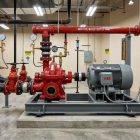
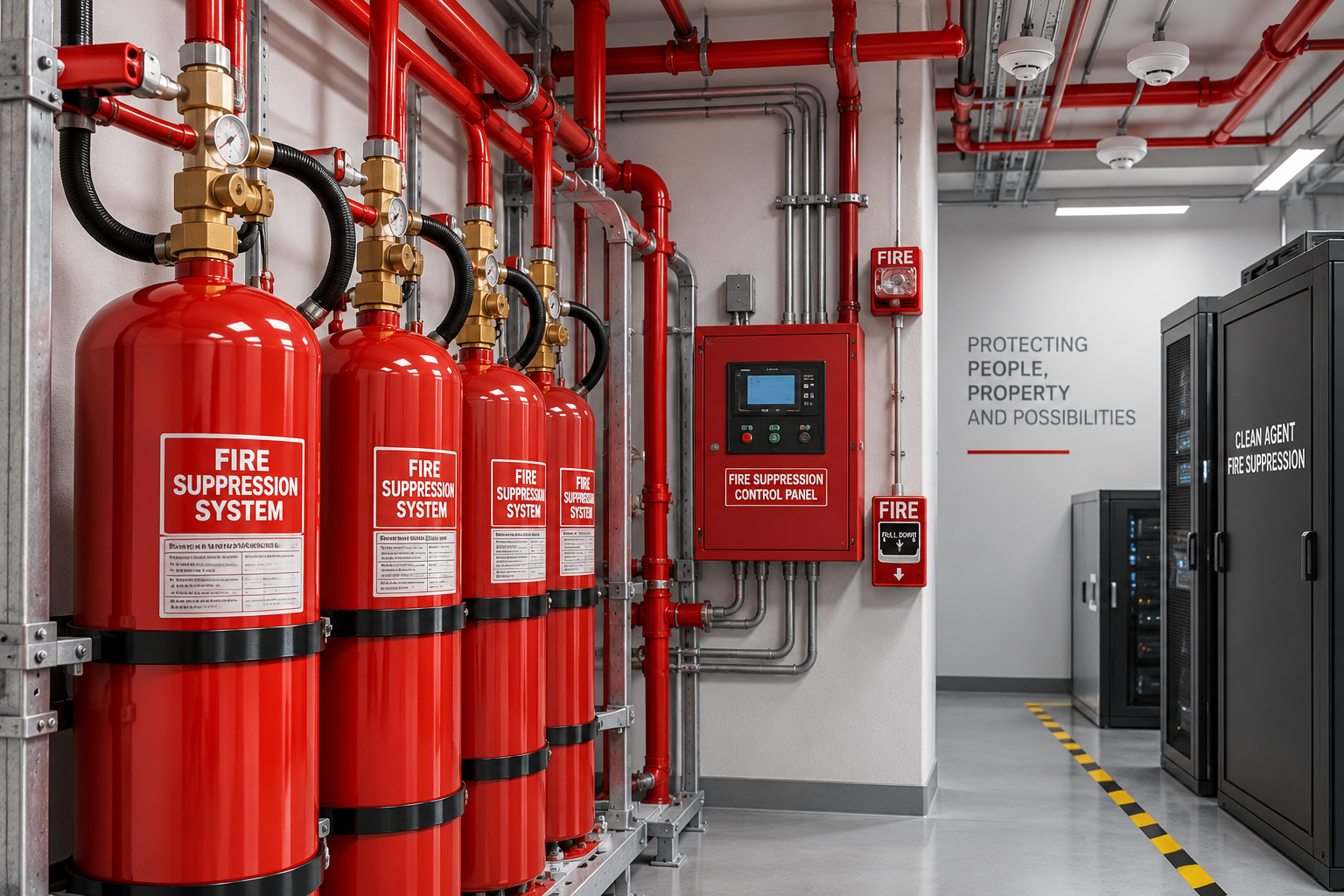
Unlike a portable extinguisher you grab and use manually, a fixed suppression unit stays permanently in place — around specific equipment or throughout a protected area — often wired into detection, alarms, control panels, piping, storage cylinders, pumps, valves, and discharge nozzles.
Which technology actually makes sense comes down to a few things: what kind of fire hazard you’re dealing with, what materials are involved, the environment itself, and how much protection the situation demands.

How Does a Fire Suppression System Work?
Every setup is a little different, but strip away the details and most of them follow the same basic logic:
- Fire detection identifies signs of a developing fire.
- Control equipment processes the detection signal.
- Alarm notification kicks in to warn occupants or trigger emergency procedures.
- Suppression equipment activates once the required conditions are met.
- The extinguishing agent gets discharged into the protected area or straight onto the hazard.
- From there, fire control or extinguishment takes over — limiting damage and stopping the fire from spreading further.
The objective isn’t simply to release an extinguishing agent — a fire suppression system only works if the agent, concentration, discharge pattern, coverage, detection method, and protected environment are all correctly engineered to work together.
OSHA describes fixed extinguishing systems as engineered installations intended to quickly extinguish developing fires and emphasizes that components should be designed and approved for the specific hazards they are expected to control or extinguish.
Why Businesses Need Fire Protection Systems
You can’t always count on someone being there when a fire starts. It might break out in an area that’s temporarily empty, inside a piece of machinery, near electrical panels, or somewhere conventional firefighting just isn’t practical.
That’s why the right fire suppression system matters — it can:
- Reduce the potential spread of fire
- Protect critical machinery and equipment
- Reduce operational disruption
- Protect valuable assets
- Support employee and occupant safety
- Limit damage to sensitive environments
- Provide an additional layer of protection alongside detection and alarm systems
- Support an organization’s broader fire-risk management strategy
Some areas simply can’t afford to gamble on this. Data processing rooms, telecommunications equipment areas, and process control rooms fall into that category — which is exactly why OSHA calls out fixed extinguishing systems as a common fit for spaces like these.
Types of Fire Protection and Suppression Technologies
Not every fire behaves the same way, so it makes sense that no single system works for every facility. The right choice depends entirely on the hazard you’re protecting against.
- Water-Based Systems
For most buildings, water remains the simplest and most trusted way to fight a fire — as long as the hazard allows for it. A typical water-based setup can take a few different forms:
- Automatic sprinklers
- Water spray systems
- Deluge systems
- Water mist systems
The science behind it is straightforward: water draws heat out of a fire, which keeps it from spreading further. What’s not so straightforward is the engineering behind it. Layout, hazard classification, water supply, obstructions, and discharge requirements all have to line up correctly, or the system won’t perform the way it’s supposed to. This isn’t left to chance — OSHA’s fire protection requirements reference established standards covering sprinkler, water spray, foam, and water mist systems.
- Foam Systems
Foam earns its place when flammable or combustible liquids are involved. Instead of just cooling the fire, it spreads a layer across the burning surface that cuts the fuel off from oxygen — starving the fire rather than just dousing it. As a fire suppression system, this makes it especially effective where water alone would fall short.
You’ll typically find foam suppression protecting:
- Fuel storage areas
- Certain industrial processing facilities
- Flammable-liquid hazards
- Specialized industrial applications
Not all foam is interchangeable, though — the type and design have to match the specific hazard, since OSHA notes some foams simply don’t perform well against certain fuels and fire scenarios.
- Dry Chemical Systems
These systems work by discharging a fine powder directly onto the fire, and they’re often the better fit where speed matters most — certain industrial and process hazards need suppression fast.
Common applications include:
- Industrial machinery
- Specialized process equipment
- Certain combustible or flammable hazards
- Commercial cooking or specialized equipment, depending on design
As with foam, the agent needs to be compatible with the hazard and installed to spec.
- Wet Chemical Systems
If you’ve ever wondered what protects a commercial kitchen, this is usually the answer. Wet chemical systems are purpose-built for cooking oil and grease fires — the kind of blaze where dousing it with water could actually make things worse.
You’ll find these systems around:
- Commercial kitchens
- Cooking appliances
- Exhaust hoods
- Frying equipment
- Restaurant cooking lines
The design needs to be built around the specific appliances and cooking layout it’s protecting.
5. Clean Agent Systems
Clean agent systems are used where fire protection is required but water or powder could damage sensitive equipment or interrupt operations.
Potential applications include:
- Data centers
- Server rooms
- Control rooms
- Telecommunications facilities
- Electrical and electronic equipment areas
- Other sensitive environments
Clean agents suppress fire without leaving the type of solid residue associated with dry chemical systems.
OSHA specifically identifies gaseous-agent systems as one category of fixed extinguishing systems and references NFPA 2001 for clean-agent fire extinguishing systems.
- Water Mist Systems
Think of this as firefighting with a much finer touch — instead of a heavy spray, water mist systems rely on very small droplets to control or put out certain fires. As a fire suppression system, it’s often chosen precisely because it uses less water than conventional sprinklers.
FM Global points to a few mechanisms behind how it actually works:
- Heat absorption
- Local oxygen displacement through water vapor
- Radiant heat blocking
But don’t mistake “less water” for “one-size-fits-all.” Water mist is highly application-specific — FM Global notes that how well it performs depends on droplet characteristics, nozzle arrangement, installation parameters, and full-scale fire testing.
In other words, you shouldn’t pick a water mist system just because it seems like the lighter option. The hazard itself, and whether it’s an approved application, is what should really drive that decision.
Where Are These Systems Used?
Fire protection and suppression technologies can be designed for many commercial, industrial, and specialized environments.
Common applications include:
| Application | Potential Suppression Solution |
| Data centers | Clean agent / specialized systems |
| Server rooms | Clean agent |
| Commercial kitchens | Wet chemical |
| Industrial facilities | Water, foam, dry chemical or specialized systems |
| Fuel-related hazards | Foam or other hazard-specific systems |
| Electrical equipment areas | Clean agent or other suitable systems |
| Warehouses | Automatic sprinkler systems |
| Process machinery | Hazard-specific suppression |
| Telecommunications facilities | Clean agent / specialized systems |
| Critical control rooms | Clean agent / specialized systems |
The final selection should always be based on a professional hazard assessment rather than simply choosing the most common option.
Key Components of a Fire Suppression System
A complete installation may contain multiple components working together.
Depending on the type, these can include:
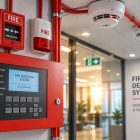
- Fire detectors
- Control panels
- Alarm devices
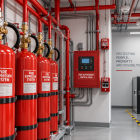
- Agent storage cylinders or tanks
- Piping networks
- Valves
- Discharge nozzles
- Sprinkler heads
- Pumps
- Pressure-monitoring devices
- Manual release stations
- Supervisory devices
- Detection and alarm interfaces
Each component has a defined role. A failure in one part can affect overall performance.
OSHA identifies components such as piping and discharge nozzles as important elements of fixed extinguishing systems and requires installations to be designed for the hazards and environmental conditions in which they operate.
Fire Protection System Design: Why Engineering Matters
A suppression solution should never be treated as a one-size-fits-all installation.
Before selecting a system, several factors should be assessed:
Fire Hazard — What materials could burn? For example: ordinary combustibles, flammable liquids, cooking oils, electrical equipment, sensitive electronics, industrial chemicals.
Protected Area — The size, ceiling height, ventilation, enclosure characteristics, equipment arrangement, and access conditions can influence the design.
Occupancy — A data center, factory, commercial kitchen, warehouse, and laboratory may require completely different protection strategies.
Extinguishing Agent — The selected agent must be suitable for the fire class and the equipment or materials being protected.
Human Safety — If an extinguishing agent could create a hazardous atmosphere, additional safety measures, warnings, evacuation procedures, and controls may be necessary.
OSHA requires employers using fixed extinguishing systems to consider hazards associated with extinguishing agents and to establish appropriate employee-safety measures.
Installation Is Only One Part of Fire Protection
Getting a system installed is just the starting point, not the finish line. A setup you can actually rely on needs ongoing attention — things like:
- Inspection
- Testing
- Preventive maintenance
- Pressure checks
- Component examination
- Alarm verification
- Valve inspection
- Agent-level checks where applicable
- Corrective repairs
- Documentation
This isn’t optional either. OSHA requires automatic fixed extinguishing systems to stay properly maintained and tested, and expects them to remain operational at all times except when actual repairs or maintenance are underway. And beyond just checking a compliance box, regular maintenance is often what catches a small problem before it turns into an emergency.
Standards and Compliance
There’s no shortcut here — every fire suppression system needs to be designed, installed, inspected, tested, and maintained in line with the standards and regulations that apply to the specific project.
Depending on the technology, relevant standards may include:
- NFPA 13 – Installation of Sprinkler Systems
- NFPA 17 – Dry Chemical Extinguishing Systems
- NFPA 17A – Wet Chemical Extinguishing Systems
- NFPA 750 – Water Mist Fire Protection Systems
- NFPA 2001 – Clean Agent Fire Extinguishing Systems
- NFPA 12 – Carbon Dioxide Extinguishing Systems
- Applicable local fire and building regulations
OSHA’s published fire-protection requirements reference several NFPA standards for different types of fixed extinguishing systems.
Important: Applicable codes and standards depend on the project location, occupancy, hazard classification, system type, and authority having jurisdiction (AHJ).
Important Fire Protection Numbers
Fire protection is one of those fields where a small detail in the design can end up making a huge difference later on. A few points worth keeping in mind:
- OSHA’s general fixed extinguishing system requirements are contained in 29 CFR 1910.160, with additional requirements for dry chemical, gaseous-agent, water spray, and foam systems.
- OSHA’s fixed-system guidance calls for installations to be inspected annually and maintained in working condition.
- FM Global identifies water mist as a specialized technology whose performance can depend on application-specific fire testing rather than a universal design approach.
- NFPA recognizes multiple suppression technologies, including water, foam, dry chemical, wet chemical, water mist, carbon dioxide, and clean-agent systems.
None of this is trivia for its own sake — it’s exactly why professional selection and ongoing maintenance matter so much.
Why Choose Mechanism Trade for Fire Protection Solutions?
We don’t look at fire suppression as just another piece of equipment to sell. At Mechanism Trade, it’s treated as a complete protection requirement — one that needs to actually work when it counts.
Here’s what shapes how we approach it:
Hazard-Based Selection — Before recommending any technology, we look closely at the specific fire risks your facility actually faces.
System Planning — The protection strategy gets built around your building, equipment, occupancy, and how the space actually operates.
Professional Installation — Components have to go in correctly, or detection, control, agent delivery, and discharge simply won’t work together the way they should.
Testing and Inspection — We test to confirm the installation is genuinely ready to perform, not just installed and assumed to work.
Maintenance Support — Ongoing inspection and maintenance catch impairments early, before they turn into real protection failures.
Practical Fire Protection — Ultimately, it comes down to balancing fire safety, operational needs, equipment protection, and the standards that apply.
Our Fire Suppression System Service Process
Picking the right technology isn’t a guessing game — it comes down to following a structured process that matches the solution to the actual hazard.
Step 1 — Site Assessment
We start by evaluating the facility itself: the equipment, occupancy, and potential fire hazards involved.
Step 2 — Hazard Identification
From there, we pin down exactly what needs protecting — the materials, processes, equipment, and specific areas at risk.
Step 3 — System Selection
Based on that hazard, we select the suppression technology that actually makes sense for it.
Step 4 — System Design
The solution then gets built out around the protected area, the coverage it needs, the components involved, and the standards it has to meet.
Step 5 — Installation
Components go in and get integrated with whatever detection and alarm infrastructure the system requires.
Step 6 — Testing & Commissioning
Before anything goes live, we check the installation to confirm it actually operates the way it’s supposed to.
Step 7 — Inspection & Maintenance
And it doesn’t stop there — ongoing maintenance keeps the system operational and ready whenever an emergency hits.
What Should You Consider Before Installing a Fire Suppression System?
Before investing in a system, facility owners and managers should ask:
- What type of fire hazard exists?
- What equipment or property needs protection?
- Could water damage critical equipment?
- Is the protected area normally occupied?
- What extinguishing agent is appropriate?
- What are the applicable local regulations?
- Which standards apply to the installation?
- Does it require integration with a fire alarm?
- How will the system be inspected and maintained?
- Who will perform future testing and repairs?
Answering these questions early can prevent inappropriate selection and costly modifications later.
Frequently Asked Questions About Fire Suppression Systems
What is the difference between a fire sprinkler and a fire suppression system? A sprinkler system is one type of fire suppression technology. The broader term includes different technologies such as sprinklers, water mist, foam, dry chemical, wet chemical, clean agents, and other engineered systems.
Is a fire suppression system suitable for every type of fire? No. The extinguishing agent must be selected according to the specific fire hazard. An agent suitable for one application may be unsuitable or dangerous for another.
Can this type of system protect electrical equipment? Yes, certain technologies can be designed for electrical and electronic equipment. Clean-agent systems are commonly considered where minimizing residue and water damage is important. However, the specific equipment and fire hazard must be assessed before selecting a solution.
How often should a fire protection system be inspected? There’s no single answer here — it really comes down to the technology involved, the standards that apply, what the manufacturer requires, and local regulations on top of that. That said, OSHA’s fixed extinguishing system guidance does set a baseline: applicable installations need to be inspected at least annually.
Does a suppression system replace a fire alarm system? Not really, no. Detection, alarm, and suppression each play a different role on their own, and they usually work best when they’re brought together as part of one coordinated fire protection strategy — not treated as substitutes for each other.
Is water mist always better than a conventional sprinkler system? No. Water mist is an application-specific technology. FM Global notes that its performance varies according to system design and hazard application, and it should not automatically be treated as a substitute for sprinkler protection.
Can Mechanism Trade help select the right system? Yes, absolutely. The right solution isn’t something you guess at — it comes from actually assessing the facility, the fire hazards involved, the equipment, occupancy, and whatever requirements apply. That’s exactly where Mechanism Trade comes in, helping businesses work through their fire protection needs and land on a strategy that actually fits.
Why Professional Fire Protection Services Matter
At the end of the day, a fire suppression system is only as good as everything that goes into it — the design, the installation, the commissioning, and how well it’s inspected and maintained afterward.
Get any of that wrong — the wrong extinguishing agent, coverage that falls short, mismatched components, sloppy installation, or maintenance that gets skipped — and the whole thing can fail to protect what it was meant to protect.
That is why businesses should consider fire suppression as a complete lifecycle service — not simply a product purchase.
Wrapping Up
A properly designed fire suppression system can provide critical protection for people, property, equipment, and business operations. From automatic sprinklers and water mist to foam, wet chemical, dry chemical, and clean-agent technologies, different systems are designed for different hazards.
The right solution begins with understanding the risk.
Mechanism Trade builds fire protection solutions around hazard assessment, system selection, installation, testing, and ongoing maintenance — not just one of those pieces, but all of them working together. Industrial equipment, commercial facilities, sensitive electronics, kitchens, or any other specialized environment — whatever you’re protecting, a properly engineered solution is what turns a fire protection strategy from adequate into genuinely reliable.
If you’re currently evaluating fire protection for your facility, reach out to Mechanism Trade. We’ll walk through your requirements together and figure out which suppression solution actually fits what you need.